Your designer wardrobe deserves better than cramped rods and scattered shoes. Explore custom closet layouts that bring boutique-level organization to Miami fashion collectors.
Share:
Summary:
Standard closets fail fashion collectors because they’re designed for average wardrobes. You don’t have an average wardrobe.
Your pieces need dedicated spaces. Structured handbags require shelves that maintain their shape. Designer shoes need visibility so you actually wear them instead of forgetting they exist. Delicate fabrics need breathing room, not compression against other garments.
The difference between a regular closet and one built for collectors comes down to zones. Each category gets its own designated area with the right type of storage. Your everyday rotation stays at eye level. Special occasion pieces go higher. Seasonal items rotate in and out without disrupting your daily flow.

Florida humidity destroys poorly stored clothing. You’ve probably seen it happen. Leather develops mildew. Fabrics absorb moisture. Metal hardware tarnishes.
Custom closets built for South Florida use materials that resist moisture damage. The finishes won’t warp when humidity spikes during summer storms. The shelving materials prevent that musty smell that creeps into standard wood systems.
Ventilation matters more in Miami-Dade County, FL than in drier climates. Your walk-in closet layout needs air circulation between hanging sections. Solid doors that trap moisture create problems. Open shelving with proper spacing protects your investment pieces.
Climate control takes this further. Some collectors add dehumidifiers or climate systems to their walk-in closets. When you’re storing thousands of dollars in designer pieces, controlling temperature and moisture stops damage before it starts. This matters whether you’re in a Coral Gables estate or a Brickell high-rise.
The right materials make a difference you’ll notice immediately. No more checking garments for spots before wearing them. No more rewashing items that picked up that closed-closet smell. Your pieces stay fresh and ready to wear.
South Florida’s weather also means you need different seasonal storage than northern climates. You’re not packing away heavy coats for eight months. Your rotation shifts more subtly between lightweight pieces and slightly heavier fabrics. The layout should accommodate this with flexible zones that adjust as your wardrobe shifts.
Florida humidity destroys poorly stored clothing. You’ve probably seen it happen. Leather develops mildew. Fabrics absorb moisture. Metal hardware tarnishes.
Custom closets built for South Florida use materials that resist moisture damage. The finishes won’t warp when humidity spikes during summer storms. The shelving materials prevent that musty smell that creeps into standard wood systems.
Ventilation matters more in Miami-Dade County, FL than in drier climates. Your walk-in closet layout needs air circulation between hanging sections. Solid doors that trap moisture create problems. Open shelving with proper spacing protects your investment pieces.
Climate control takes this further. Some collectors add dehumidifiers or climate systems to their walk-in closets. When you’re storing thousands of dollars in designer pieces, controlling temperature and moisture stops damage before it starts. This matters whether you’re in a Coral Gables estate or a Brickell high-rise.
The right materials make a difference you’ll notice immediately. No more checking garments for spots before wearing them. No more rewashing items that picked up that closed-closet smell. Your pieces stay fresh and ready to wear.
South Florida’s weather also means you need different seasonal storage than northern climates. You’re not packing away heavy coats for eight months. Your rotation shifts more subtly between lightweight pieces and slightly heavier fabrics. The layout should accommodate this with flexible zones that adjust as your wardrobe shifts.
Want live answers?
Connect with a Miami Design Group expert for fast, friendly support.
Not every collector has the same needs. Someone with fifty pairs of shoes requires different solutions than someone with fifty handbags. The five layouts below address different collection focuses.
Your space dimensions matter too. A square walk-in works differently than a long, narrow space. Corner areas can become dead zones or highly functional storage depending on your layout choice. Ceiling height determines whether you can add upper storage without needing a step stool every morning.
Each layout prioritizes specific storage types while accommodating everything else. Pick the one that matches your largest collection category or your biggest current frustration.

The U-shaped layout with a center island works best when you have at least 100 square feet of space. Storage wraps three walls with a functional island in the middle. You get the highest storage capacity of any luxury closet configuration.
The three walls provide distinct zones. One wall handles hanging clothes with a mix of double-hang sections for separates and long-hang areas for dresses and coats. The second wall becomes your display area with open shelving for shoes and handbags. The third wall holds drawers and closed storage for items that don’t need visibility.
The center island adds functionality most layouts lack. The top surface gives you a place to lay out outfits or fold items. Drawers underneath store accessories, jewelry, undergarments, or folded pieces. Some collectors add a cushioned top section for seating. Others incorporate pull-out trays for watches or sunglasses.
This layout requires careful planning around the island. You need at least 36 inches of clearance on all sides for comfortable movement. Tighter spaces feel cramped. Wider clearances let you pull out drawers without doing an awkward shuffle.
The island also provides a visual anchor. Walking into a large closet can feel overwhelming when storage goes floor to ceiling on all sides. The island breaks up the space and gives your eye somewhere to land. It makes the room feel more like a dressing room and less like a storage facility.
Lighting works differently with this layout. You need illumination from multiple angles since the island creates shadows. Overhead lights combined with under-shelf LEDs ensure every area stays visible. Some collectors in Aventura and Fort Lauderdale add a small chandelier above the island for that boutique atmosphere.
Corner closets often become dead zones where items disappear into darkness. The L-shaped layout turns that problem corner into functional storage. This works particularly well in Broward County, FL condos where closet spaces follow building architecture rather than ideal dimensions.
The key is how you handle the corner itself. Lazy Susans waste vertical space but provide easy access. Corner shelving units with angled fronts let you see everything without awkward reaching. Some layouts skip the corner entirely and use that space for a floor-to-ceiling mirror, turning a problem area into a functional feature.
One leg of the L typically handles hanging clothes. The other becomes your display and storage wall. This separation keeps your daily routine flowing smoothly. You’re not crossing back and forth across the entire closet to build an outfit.
The L-shape naturally creates a getting-ready zone near the corner. Add a small bench or ottoman here. It becomes your spot for putting on shoes or setting down items while you decide what to wear. This dedicated area keeps the rest of your closet from becoming a dumping ground for pieces you tried on but didn’t choose.
Smaller L-shaped closets work better with this layout than trying to force a U-shape into insufficient space. You maintain good traffic flow without that cramped feeling. The open side of the L provides easy entry and exit without navigating around furniture.
This layout also adapts well when couples share a closet. Each person gets one leg of the L. The corner area becomes shared space for items you both use or seasonal storage that rotates. Clear division prevents the “your stuff is creeping into my section” arguments that plague shared closets.
The L-configuration particularly suits master bedrooms in Miami-Dade County, FL homes where the closet connects to the bathroom. You create a natural flow from closet to vanity area without backtracking through the bedroom. This matters more than you’d think during rushed mornings.
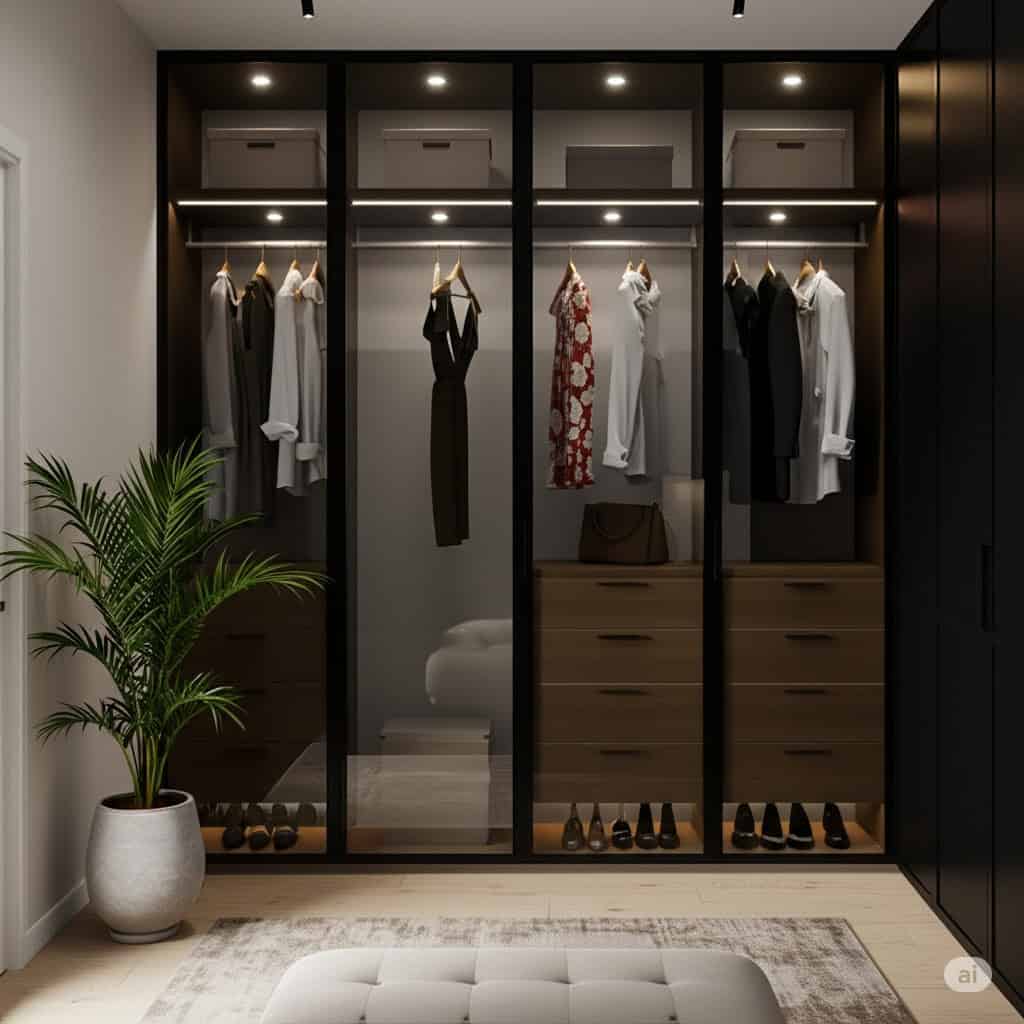
Not every fashion collector has a massive walk-in space. The straight wall layout maximizes storage along a single wall, typically 8 to 12 feet wide. This works in reach-in closets or smaller walk-in spaces where other layouts won’t fit.
The secret is vertical organization. Double-hang sections on one side hold tops, blouses, and folded pants. Long-hang sections on the other accommodate dresses and coats. The middle section features shelving for shoes, handbags, and folded items. Everything stays accessible without wasted space.
Upper shelves store items you don’t need daily. Seasonal pieces rotate up here. Luggage or special occasion clutches find a home. Lower shelves or drawers handle everyday accessories. This vertical zoning means you’re not stretching or bending for items you use regularly.
Lighting becomes critical in straight wall layouts. Without depth, shadows hide items. LED strips mounted under each shelf level illuminate your entire collection. Motion sensors mean lights activate when you open the closet. No more fumbling for switches while holding clothes.
Color coordination shows best in this layout. When everything’s visible on one wall, you spot patterns immediately. Group by color or by item type. Either works. The key is consistency so your brain knows where to look for specific pieces.
This configuration suits condos throughout Hallandale Beach and Hollywood where space comes at a premium. You get serious storage capacity without requiring a dedicated room. The closet functions more like a built-in wardrobe than a traditional walk-in, but the organization level matches much larger spaces.
Article details:
Share:
Continue learning: