Miami's intense sun drives up energy bills. Learn which window treatments block heat, cut cooling costs by 25%, and work best in South Florida's climate.
Share:
Summary:
Miami’s climate is brutal on both your comfort and your wallet. With an average of 133 days per year above 90°F, your air conditioner isn’t just working hard—it’s fighting for its life. Air conditioning typically accounts for 40% of your electric bill in Miami-Dade County, and during peak summer, that percentage climbs faster than the humidity.
Windows are the weak point. Without proper coverings, up to 50% of your home’s cooling energy escapes right through the glass. The sun heats the panes, that heat transfers inside, and your HVAC system struggles to keep up. It’s essentially like trying to keep a convertible cool with the top down—it’s expensive, loud, and ultimately futile.
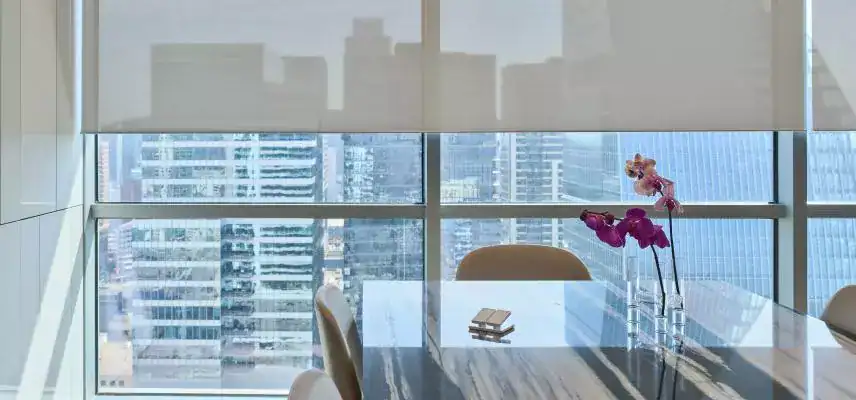
Understanding how window treatments save energy helps you choose the right solution. It comes down to three mechanisms: blocking solar heat gain, providing insulation, and controlling airflow.
Solar heat gain is the primary culprit. When sunlight hits your windows, it converts to heat inside. Quality window treatments can reduce this heat gain by up to 77%. Think of it as a “Force Shield” for your house, but instead of blocking blasters, it’s blocking the 3 PM sun that’s trying to melt your remote control.
Insulation works both ways. Cellular shades, for example, trap air in honeycomb-shaped pockets. This creates “dead air space” that slows heat transfer. If you’ve ever wondered why your $250 bill didn’t buy you a comfortably cool house, it’s probably because your windows have the R-value of a wet paper bag. Custom-fitted treatments eliminate gaps, guaranteeing that the cool air you paid for stays inside.
Understanding how window treatments save energy helps you choose the right solution. It comes down to three mechanisms: blocking solar heat gain, providing insulation, and controlling airflow.
Solar heat gain is the primary culprit. When sunlight hits your windows, it converts to heat inside. Quality window treatments can reduce this heat gain by up to 77%. Think of it as a “Force Shield” for your house, but instead of blocking blasters, it’s blocking the 3 PM sun that’s trying to melt your remote control.
Insulation works both ways. Cellular shades, for example, trap air in honeycomb-shaped pockets. This creates “dead air space” that slows heat transfer. If you’ve ever wondered why your $250 bill didn’t buy you a comfortably cool house, it’s probably because your windows have the R-value of a wet paper bag. Custom-fitted treatments eliminate gaps, guaranteeing that the cool air you paid for stays inside.
Want live answers?
Connect with a Miami Design Group expert for fast, friendly support.
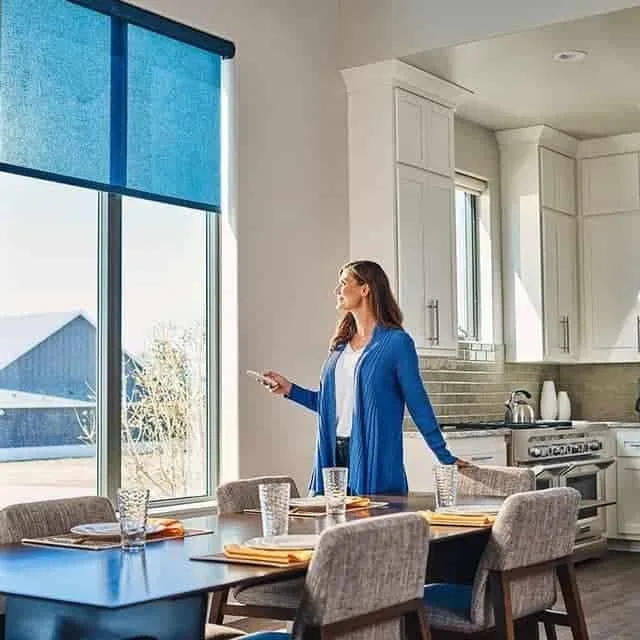
Motorization isn’t just a party trick to show off to your friends—though it is a very good one. It’s about maximizing efficiency. When your shades adjust automatically based on the sun’s position, they optimize performance without you having to lift a finger (or even be home).
Smart treatments integrate with Alexa, Google Home, and Apple HomeKit. You can schedule them to close at 2 PM when the sun starts its daily “microwave mode” and open at sunset. It’s the ultimate “set it and forget it” move that lowers your FPL bill.
The secret to energy savings is consistency. Studies show that 75% of window coverings stay in the same position all day. If you leave your shades open when you head to work, you’re essentially inviting the sun to rearrange your interior temperature while you’re gone.
Motorized systems solve this. You can program them to close when the afternoon sun hits your west-facing windows. This prevents “hot spots” where the sun streams through, forcing your AC to run a marathon just to maintain 74 degrees. It’s like having a tiny, invisible butler whose only job is to fight the sun for you.
In Miami, material selection is a survival choice. You need moisture resistance. Avoid untreated natural fibers; they absorb humidity and eventually develop an “earthy” scent (otherwise known as mold). UV Resistance is equally critical. Miami sun treats unprotected fabric like a bleach bath. Look for solution-dyed fabrics where the color is baked in, not just printed on. If you live near the coast, salt air adds another layer of fun. You’ll want stainless steel hardware and powder-coated frames, or you’ll find your “metal” components looking like they were recovered from a shipwreck within two years.
Eco-friendly window treatments aren’t an expense—they’re a 10-to-15-year investment that pays you back in lower utility bills and a couch that doesn’t feel like a heated seat.
Focus on materials that can handle the humidity and technology that can handle the scheduling. Your AC—and your wallet—will thank you.
Article details:
Share:
Continue learning: