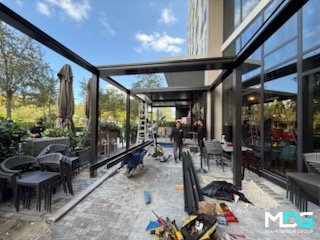
Boca Raton's luxury homes are redefining outdoor living with "hidden" design—motorized pergolas that adjust to the sun, retractable screens that disappear, and smart automation that works invisibly.
Share:

Summary:
Traditional outdoor structures are static. A fixed pergola provides the same partial shade regardless of sun angle or weather. Standard screens stay in place whether you’re using them or not. You adapt to what the structure offers rather than the structure adapting to you.
Motorized systems flip that relationship. Louvered pergolas rotate their slats to block direct sun or open completely for stargazing. Retractable screens deploy when bugs emerge at dusk and disappear when you want an unobstructed view. Automated awnings extend during peak heat and retract before wind gusts damage them.
For Boca Raton’s climate—intense sun, sudden storms, high humidity, salt air—this flexibility matters. Your outdoor kitchen, pool area, or lanai needs to function in conditions that change throughout the day and across seasons. Static structures force compromises. Motorized systems eliminate them by adapting to whatever the moment requires.
Walk past most screened enclosures and you immediately see the framework. Posts, tracks, fabric panels—all permanently visible even when you’d prefer an open view of your pool or landscaping.
Motorized retractable screens solve this by disappearing when not in use. The screen fabric rolls into a compact cassette mounted above your opening—typically just 4-6 inches deep. When deployed, the screen provides full insect protection and sun filtering. When retracted, it’s nearly invisible, leaving you with an unobstructed opening.
The cassette housing can be powder-coated to match your home’s trim color. Mounted inside the pergola structure or along the roofline, it blends into the architecture rather than announcing itself as an add-on. Side channels guide the fabric without visible tracks interrupting your sightlines.
For Boca Raton applications, material selection is critical. Marine-grade screen fabrics resist UV degradation and mildew in humid conditions. Stainless steel or aluminum components withstand salt air corrosion near the coast. Quality motors operate quietly and include wind sensors that automatically retract the screen if gusts exceed safe thresholds—essential during Florida’s unpredictable weather patterns.
You’ll find these screens on pergolas, lanais, outdoor kitchens, and pool enclosures throughout South Florida. They create spaces that serve dual purposes without compromise. When you’re entertaining and want the area open, the screens retract. When mosquitoes appear during dinner, they deploy with a remote tap. The space adapts instead of forcing you to choose between protection and aesthetics.
Installation requires precision to ensure smooth operation. The screen must deploy evenly without binding, and side channels need proper sealing to actually keep insects out. Cheaper systems develop gaps or the fabric warps in humidity within a season. That’s why professional installation using quality components designed specifically for Florida’s environment makes the difference between a feature that works reliably for years and one that becomes a maintenance headache.
The control options range from simple remote operation to full smart home integration. Basic systems use a dedicated remote. Mid-range options connect to your home’s Wi-Fi for smartphone control. High-end installations integrate with automation systems like Control4 or Crestron, allowing the screens to respond automatically to sun sensors, weather conditions, or preset schedules.
Walk past most screened enclosures and you immediately see the framework. Posts, tracks, fabric panels—all permanently visible even when you’d prefer an open view of your pool or landscaping.
Motorized retractable screens solve this by disappearing when not in use. The screen fabric rolls into a compact cassette mounted above your opening—typically just 4-6 inches deep. When deployed, the screen provides full insect protection and sun filtering. When retracted, it’s nearly invisible, leaving you with an unobstructed opening.
The cassette housing can be powder-coated to match your home’s trim color. Mounted inside the pergola structure or along the roofline, it blends into the architecture rather than announcing itself as an add-on. Side channels guide the fabric without visible tracks interrupting your sightlines.
For Boca Raton applications, material selection is critical. Marine-grade screen fabrics resist UV degradation and mildew in humid conditions. Stainless steel or aluminum components withstand salt air corrosion near the coast. Quality motors operate quietly and include wind sensors that automatically retract the screen if gusts exceed safe thresholds—essential during Florida’s unpredictable weather patterns.
You’ll find these screens on pergolas, lanais, outdoor kitchens, and pool enclosures throughout South Florida. They create spaces that serve dual purposes without compromise. When you’re entertaining and want the area open, the screens retract. When mosquitoes appear during dinner, they deploy with a remote tap. The space adapts instead of forcing you to choose between protection and aesthetics.
Installation requires precision to ensure smooth operation. The screen must deploy evenly without binding, and side channels need proper sealing to actually keep insects out. Cheaper systems develop gaps or the fabric warps in humidity within a season. That’s why professional installation using quality components designed specifically for Florida’s environment makes the difference between a feature that works reliably for years and one that becomes a maintenance headache.
The control options range from simple remote operation to full smart home integration. Basic systems use a dedicated remote. Mid-range options connect to your home’s Wi-Fi for smartphone control. High-end installations integrate with automation systems like Control4 or Crestron, allowing the screens to respond automatically to sun sensors, weather conditions, or preset schedules.
Want live answers?
Connect with a Miami Design Group expert for fast, friendly support.
Individual motorized features improve convenience. Connecting them through home automation transforms how your outdoor space functions.
When your pergola, retractable screens, exterior shades, awnings, and lighting operate through a unified system, your outdoor areas respond to conditions and preferences automatically. The afternoon sun hits a certain angle, and west-facing exterior shades deploy. Evening arrives, and landscape lighting fades up while pergola louvers open. A storm approaches, and everything closes before the first drops fall.
This integration is what separates functional outdoor living from truly smart outdoor living in Boca Raton. You’re not managing components with multiple remotes—you’re setting scenes and schedules that execute on their own. The technology works constantly, but you’re not interacting with it unless you choose to override the automation.

Your outdoor pergola and screens don’t exist in isolation. They’re part of a larger environment that includes the interior spaces they connect to—typically rooms with large windows or sliding glass doors facing your patio, pool, or lanai.
Smart home automation bridges indoor and outdoor elements into cohesive control. Your motorized interior window treatments coordinate with exterior shading to manage heat gain throughout the day. When the system detects intense sun on south-facing windows, it deploys both the exterior awning and interior roller shades for maximum heat blocking. When the sun moves and direct exposure ends, the awning retracts to restore your view while interior shades remain partially lowered for glare control.
This coordination happens automatically through sun sensors and programmed logic. You’re not manually adjusting multiple window treatments and outdoor shades throughout the day. The system monitors conditions and responds appropriately, reducing cooling costs while maintaining comfortable light levels and preserving your views when possible.
Voice control adds convenience for manual overrides. You’re grilling on the patio and the sun shifts into your eyes—you tell Alexa to close the west pergola louvers without putting down your spatula. Guests arrive and you want the screens retracted for an open view—one voice command handles it across multiple motorized elements simultaneously.
The real value emerges in automation based on environmental conditions rather than just schedules. Temperature sensors detect when outdoor heat would increase cooling loads and automatically deploy exterior shading. Wind sensors retract awnings before gusts damage the fabric. Rain sensors close pergola louvers and retract screens to protect furniture. These responses happen without your input, making the system truly “hidden” in daily operation.
For Boca Raton’s climate, this addresses practical realities. The sun is intense from May through October. Afternoon storms are common year-round. Humidity is constant. Managing outdoor and window treatments manually means constant adjustments as conditions change. Automation means the space adapts while you’re at work, traveling, or simply focused on other activities.
Professional integration is essential for reliable operation. The motorized components need to communicate with the central automation hub through robust protocols—typically wireless using Z-Wave or Zigbee, sometimes hardwired for critical elements. Programming the scenes and automation rules requires expertise to ensure the system responds appropriately without false triggers, conflicting commands, or excessive battery drain on wireless components.
Smartphone apps provide monitoring and control from anywhere. You’re at the office and realize you left the pergola louvers open with rain in the forecast—you close them remotely. You’re on vacation and want to adjust the automated schedule—you modify it from your phone. The system gives you control when you want it while handling routine adjustments automatically.
South Florida cooling costs dominate electricity bills from May through October. Your AC runs constantly, fighting against heat gain through windows and glass doors that face the afternoon sun.
Automated exterior shading addresses this at the source. By blocking sun before it enters your home, you prevent heat gain rather than trying to remove it after the fact. Motorized awnings over windows, exterior roller shades on sliding glass doors, and louvered pergolas positioned to shade large expanses of glass can reduce cooling costs by 25-30% during peak season.
The key is automation. Manual awnings require you to extend them each morning and retract them each evening—a routine most people abandon within weeks. Automated systems handle it based on sun position, outdoor temperature, or time of day. The shades deploy when heat gain would be highest and retract when it’s not an issue, maintaining your views when possible while maximizing energy savings.
This creates cost reduction without requiring behavior changes. Your home stays cooler, your AC runs less frequently, and your electricity bills drop. Over a typical South Florida summer, that translates to several hundred dollars in savings—money that offsets the automation investment over time while providing ongoing benefits year after year.
Exterior shading also protects furnishings. UV exposure fades fabrics, damages wood finishes, and degrades artwork. By blocking sun before it enters your home, automated awnings and exterior shades extend the life of expensive interiors. That’s additional value beyond the energy savings—preservation of investments you’ve already made in furniture, flooring, and window treatments.
Installation positioning is critical for maximum effectiveness. Shades need to cover glass during peak sun hours for your home’s specific orientation. South and west-facing windows typically need the most coverage in Boca Raton. We evaluate your home’s sun exposure patterns and recommend placement that maximizes both energy savings and aesthetic integration with your architecture.
The technology itself has improved significantly in recent years. Modern motors operate quietly, reliably, and efficiently. Solar-powered options eliminate wiring concerns for certain installations—the awning or shade recharges its battery during the day and operates on stored power. Battery-powered systems offer installation flexibility without electrical work. Hardwired systems provide unlimited power for large or frequently-operated installations. The choice depends on your specific situation, budget, and preferences.
Fabric selection matters for both performance and longevity. Solution-dyed acrylic fabrics like Sunbrella resist fading and mildew in Florida’s humid environment. Solar screen fabrics block heat and UV while maintaining outward visibility. Opaque fabrics provide complete sun blocking for maximum heat rejection. We recommend fabric based on your specific sun exposure and goals—whether that’s heat reduction, glare control, or complete privacy.
What you get is a home that manages its own energy efficiency. The exterior shading adjusts automatically throughout the day, your cooling costs drop measurably, and your interiors stay protected—all without visible technology cluttering your windows or requiring daily attention. The system works behind the scenes, which is exactly the point of “hidden” design in outdoor living.
The “hidden” approach to outdoor design isn’t about concealment for its own sake. It’s about integration. When louvered pergolas adjust themselves, retractable screens disappear when not needed, and automation responds to conditions without your input, you’re experiencing design where function and form achieve balance.
In Boca Raton’s luxury market, this aligns with how homeowners actually live. You want outdoor spaces that work in South Florida’s demanding climate without constant management. You want technology that enhances your lifestyle without announcing itself. You want design that looks intentional and architectural, not like a collection of visible mechanisms and hardware.
That’s what happens when motorized screens, smart pergolas, automated exterior shades, and integrated home systems work together. Your outdoor living space becomes an extension of your home that adapts to sun, weather, and your preferences—while maintaining the clean aesthetic that makes South Florida architecture distinctive. The technology serves you without showing itself.
We specialize in creating these integrated outdoor environments throughout Boca Raton and South Florida. From motorized window treatments and retractable screens to aluminum louvered pergolas, awnings, and complete home automation systems, we handle the full scope of making outdoor spaces both beautiful and functional. Our experience with Florida’s unique climate challenges—intense sun, salt air, humidity, hurricanes—ensures solutions that perform reliably year after year without excessive maintenance.
Article details:
Share:
Continue learning: