AI-integrated motorized window treatments are revolutionizing South Florida homes in 2026, offering voice control, automated scheduling, and seamless smart home integration for truly effortless living.
Share:
Summary:
Let’s clear up what this actually means. AI-integrated motorized window treatments aren’t just blinds with a remote control. They’re systems that learn, adapt, and make decisions based on real data from your home and your habits.
The motors themselves have evolved. Gone are the clunky, visible mechanisms that screamed “retrofit.” Today’s systems are sleek, often battery-operated, and integrate seamlessly with voice assistants like Alexa, Google Home, and Apple HomeKit. But the real intelligence comes from how they interact with your entire smart home ecosystem.
These systems track the sun’s position using your home’s GPS coordinates. They monitor indoor temperature and adjust automatically to reduce heat gain. They learn your schedule—when you wake up, when you leave for work, when you prefer privacy in the evening—and anticipate your needs without constant programming. That’s the difference between automation and actual intelligence.

Voice control sounds futuristic until you realize how practical it becomes in daily life. You’re cooking dinner with your hands full, and the afternoon sun is creating glare on your kitchen counter. Instead of stopping what you’re doing, you simply say, “Alexa, close the kitchen shades.” Done.
The technology behind this is straightforward but sophisticated. Your motorized shades connect to a smart hub that communicates with your home’s WiFi network. This hub acts as a translator between your voice assistant and your window treatments, sending commands to the motors in real time.
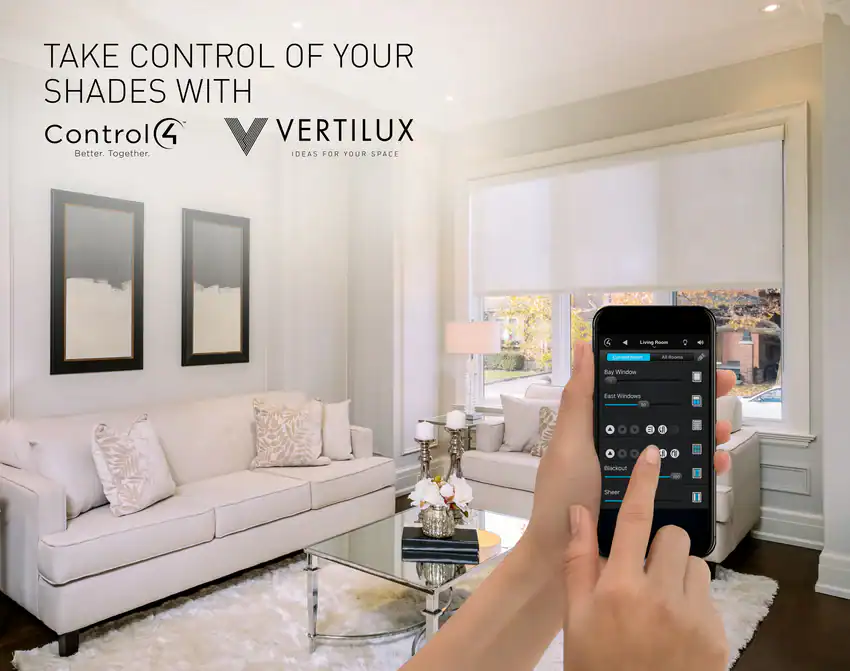
Most systems today support multiple platforms simultaneously. You’re not locked into one ecosystem. Whether you prefer Apple’s Siri, Amazon’s Alexa, or Google Assistant, your shades respond. Some advanced systems even work with Samsung SmartThings and home automation platforms like Control4, Crestron, or Savant for whole-home integration.
The setup is simpler than you’d expect. After professional installation, you name each window or group of windows in your control app. “Living room shades,” “bedroom blinds,” “all south-facing windows”—whatever makes sense for how you think about your space. From there, voice commands become second nature.
But voice control is just one layer. The real convenience comes from automation that doesn’t require any input at all. Your shades can open gradually in the morning to wake you with natural light instead of a jarring alarm. They can close automatically during peak sun hours to reduce cooling costs. They can lower when you arm your security system and raise when you arrive home, all without you touching a button or speaking a word.
For families with children, elderly relatives, or anyone with mobility challenges, this isn’t just convenient—it’s genuinely helpful. Hard-to-reach windows that once stayed closed for months become fully functional again. Tall windows that required a step stool are now manageable from anywhere in the room.
Voice control sounds futuristic until you realize how practical it becomes in daily life. You’re cooking dinner with your hands full, and the afternoon sun is creating glare on your kitchen counter. Instead of stopping what you’re doing, you simply say, “Alexa, close the kitchen shades.” Done.
The technology behind this is straightforward but sophisticated. Your motorized shades connect to a smart hub that communicates with your home’s WiFi network. This hub acts as a translator between your voice assistant and your window treatments, sending commands to the motors in real time.
Most systems today support multiple platforms simultaneously. You’re not locked into one ecosystem. Whether you prefer Apple’s Siri, Amazon’s Alexa, or Google Assistant, your shades respond. Some advanced systems even work with Samsung SmartThings and home automation platforms like Control4, Crestron, or Savant for whole-home integration.
The setup is simpler than you’d expect. After professional installation, you name each window or group of windows in your control app. “Living room shades,” “bedroom blinds,” “all south-facing windows”—whatever makes sense for how you think about your space. From there, voice commands become second nature.
But voice control is just one layer. The real convenience comes from automation that doesn’t require any input at all. Your shades can open gradually in the morning to wake you with natural light instead of a jarring alarm. They can close automatically during peak sun hours to reduce cooling costs. They can lower when you arm your security system and raise when you arrive home, all without you touching a button or speaking a word.
For families with children, elderly relatives, or anyone with mobility challenges, this isn’t just convenient—it’s genuinely helpful. Hard-to-reach windows that once stayed closed for months become fully functional again. Tall windows that required a step stool are now manageable from anywhere in the room.
Want live answers?
Connect with a Miami Design Group expert for fast, friendly support.
Let’s talk about what actually matters: how these systems improve your daily life and your bottom line. The benefits fall into three categories—convenience, cost savings, and safety—and they’re all more significant than most people expect before installation.
Convenience is obvious but profound. You control every window in your home from your phone, from anywhere in the world. Forgot to close the shades before leaving for vacation? Handle it from the airport. Want to let in morning light without getting out of bed? Done. Need to adjust multiple windows at once? One tap controls them all.
But the real convenience comes from not having to think about it at all. Automated scheduling means your home adapts to your routine automatically. Energy savings happen in the background. UV protection for your furniture is constant and consistent. Your home just works better, with less effort from you.
Energy efficiency isn’t a vague promise—it’s measurable, and the numbers are compelling. In South Florida’s climate, your air conditioning works harder than almost anywhere else in the country. Anything that reduces that load translates directly to lower monthly bills.
Motorized window treatments reduce energy costs in several specific ways. First, they block solar heat gain during the hottest parts of the day. When programmed correctly, your shades close automatically before the afternoon sun turns your living room into a greenhouse. This prevents heat from entering in the first place, which is far more efficient than trying to cool it down after the fact.
Second, they provide insulation that works both ways. Cellular or honeycomb shades, when motorized, create pockets of trapped air that act as barriers. In summer, they keep hot air out. During Miami’s brief cooler months, they help retain warmth inside. This consistent temperature regulation means your HVAC system cycles less frequently, reducing wear and extending its lifespan while cutting your utility bills.
Third, and this is where AI integration really shines, smart shades learn optimal patterns. They track when sunlight hits specific windows, monitor indoor temperature changes, and adjust automatically to maintain your preferred comfort level with minimal energy use. Over time, the system becomes more efficient as it learns your home’s unique characteristics—which windows get morning sun, which rooms heat up fastest, when you typically need the most light.
The Department of Energy research shows that window coverings can reduce heat gain by up to 77% in warm climates. For a typical South Florida home, that translates to annual savings of $100 to $200 or more, depending on your home’s size and window exposure. When you factor in the extended lifespan of your HVAC system due to reduced strain, the long-term financial benefit becomes even more significant.
Smart scheduling amplifies these savings. Your shades can be programmed to work with your utility company’s time-of-use rates, keeping your home cooler during peak pricing hours when electricity is most expensive. They can also integrate with weather forecasts, adjusting preemptively when the system knows a particularly hot day is coming.
Beyond energy savings, motorized window treatments deliver benefits that many homeowners don’t consider until after installation. Safety tops the list, especially for families with young children or pets. Corded window treatments pose a genuine strangulation hazard—it’s not common, but it happens, and it’s preventable. Motorized systems eliminate cords entirely, removing that risk from your home.
Accessibility is another major advantage that becomes obvious once you experience it. If you have tall windows, windows above staircases, or skylights, manual operation ranges from inconvenient to impossible. Motorized systems make every window in your home equally accessible regardless of height or location. For elderly family members or anyone with mobility limitations, this isn’t a luxury—it’s practical independence.
The aesthetic improvement is subtler but real. Motorized treatments offer a clean, streamlined appearance without visible cords or chains. The look is modern and uncluttered, which matters more than you might think when you’re living with these windows every day. Many homeowners report that their spaces simply feel more polished and intentional after installation.
Home value impact is harder to quantify but increasingly documented. ROI estimates for motorized window treatments range from 50% to 70% of the installation cost, particularly in markets where smart home features are expected rather than exceptional. In Miami-Dade and Broward Counties, where tech-savvy buyers are common and energy efficiency is a priority, these systems can genuinely differentiate your property.
Real estate agents consistently report that homes with smart features—including automated window treatments—generate more interest and often sell faster than comparable properties without them. The automation and convenience appeal to modern buyers who expect their homes to be as technologically current as their cars and phones.
Longevity is another benefit worth mentioning. Manual window treatments wear out from daily use—pulling cords, yanking chains, forcing stuck mechanisms. Motorized systems eliminate that physical stress. The motors are designed for thousands of cycles, and because the movement is smooth and controlled, the fabric and mechanisms last longer. Many systems come with warranties of five to ten years, and with minimal maintenance, they often exceed that lifespan significantly.
UV protection deserves special attention in South Florida. The intense sun doesn’t just heat your home—it damages everything inside it. Furniture fades, hardwood floors discolor, artwork deteriorates. Motorized shades that automatically close during peak UV hours provide consistent protection that manual shades simply can’t match. You’re not relying on remembering to close them; the system handles it automatically, preserving your investment in your home’s interior.
The technology has matured. The integration is seamless. The benefits—from energy savings to daily convenience to genuine safety improvements—are real and measurable. For Miami-Dade and Broward County homeowners dealing with intense sun, high cooling costs, and the desire for smarter living spaces, AI-integrated motorized window treatments aren’t just a trend. They’re a practical solution to everyday challenges.
You don’t need to automate every window at once. Many homeowners start with high-priority areas—bedrooms for better sleep, living spaces for energy efficiency, hard-to-reach windows for accessibility—and expand from there. The systems are modular and expandable, growing with your needs and budget.
The investment varies depending on your window sizes, the number of windows, and the level of integration you choose, but typical installed costs range from $300 to $1,000 per window. When you factor in energy savings, extended HVAC lifespan, and increased home value, the return is compelling. If you’re ready to explore how systems from industry leaders like Hunter Douglas, Lutron, and Somfy can work in your specific space, we bring 15 years of design expertise and comprehensive smart home integration to South Florida. Your home should work for you—not the other way around.
Article details:
Share:
Continue learning: