Modern awnings aren't your grandmother's striped canopies. Today's designs blend sleek aesthetics with smart technology—because your patio shouldn't feel like a 1950s barbershop.
Share:
Summary:
Traditional awnings were purely functional. They were the “utilitarian socks” of the homeworld—they worked, but they weren’t exactly a fashion statement.
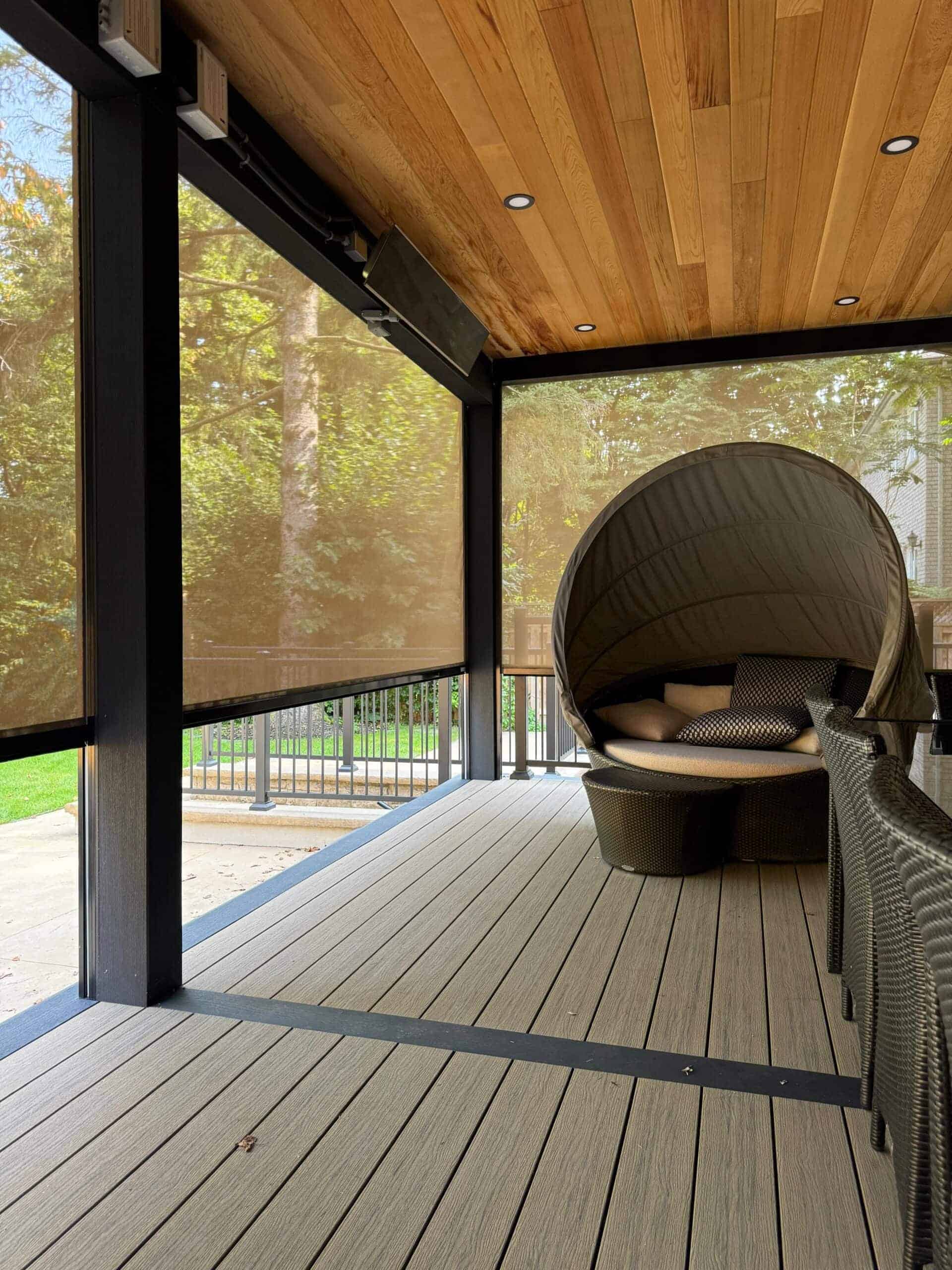
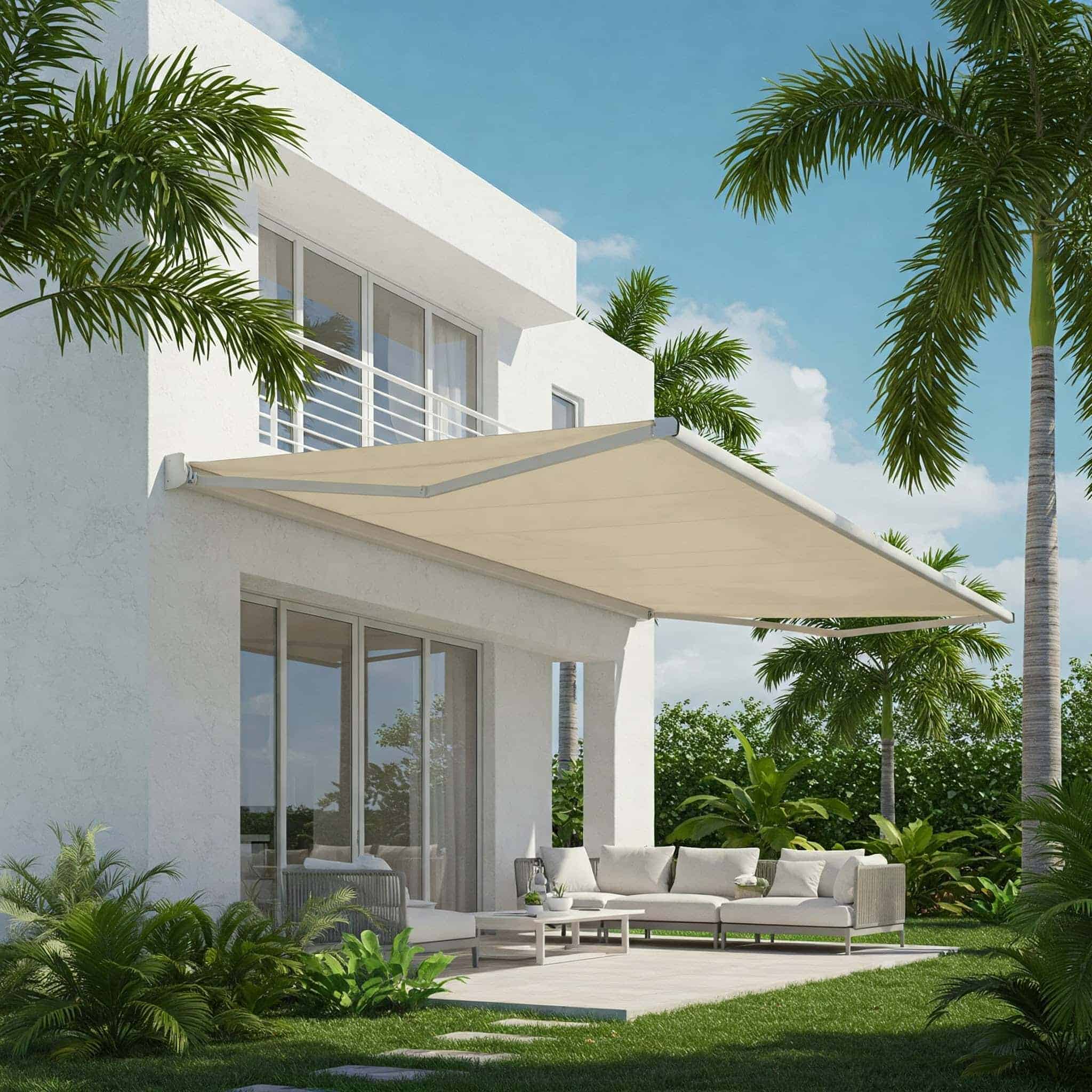
Modern awnings take a completely different approach. We’re talking about powder-coated aluminum frames that handle Miami’s humidity without rusting into a pile of orange flakes. The fabrics are now engineered for UV resistance, with designs that match sleek, contemporary Miami architecture.
The real magic is the integration. We’ve gone from manual hand-cranks (a great workout, but nobody wants to do it at 100 degrees) to smart home automation. You can now adjust your shade from your phone or set up a Bond Bridge Pro to sync your awnings with your Lutron or Control4 system. Your house is officially smarter than you are—and definitely more relaxed.

Miami’s climate is basically an endurance test for building materials. Between the salt air, intense UV rays, and afternoon monsoons, anything you put outside needs to be tougher than a South Beach bouncer.
Modern fabrics use solution-dyed acrylics from brands like Phifer or Fabricut. These aren’t just painted on; the color is part of the fiber. This means they don’t fade after two weeks of August sun. Even better, these fabrics are breathable. Older awnings used to trap heat like a plastic bag; modern ones let air circulate, so it’s actually 15-20 degrees cooler underneath.
The frames are the unsung heroes. Aluminum is the king here. It doesn’t rust, it’s lightweight, and it’s strong. It’s the same material used in high-end jets, which is fitting because some of these retractable systems look like they’re ready for takeoff.
Miami’s climate is basically an endurance test for building materials. Between the salt air, intense UV rays, and afternoon monsoons, anything you put outside needs to be tougher than a South Beach bouncer.
Modern fabrics use solution-dyed acrylics from brands like Phifer or Fabricut. These aren’t just painted on; the color is part of the fiber. This means they don’t fade after two weeks of August sun. Even better, these fabrics are breathable. Older awnings used to trap heat like a plastic bag; modern ones let air circulate, so it’s actually 15-20 degrees cooler underneath.
The frames are the unsung heroes. Aluminum is the king here. It doesn’t rust, it’s lightweight, and it’s strong. It’s the same material used in high-end jets, which is fitting because some of these retractable systems look like they’re ready for takeoff.
Want live answers?
Connect with a Miami Design Group expert for fast, friendly support.
Let’s talk money, because a quality awning isn’t just a purchase; it’s an investment. In Miami, windows are the biggest source of “heat gain.” It’s like leaving the oven door open while the AC is trying to cool the house.
Studies show that properly placed awnings can reduce cooling energy use by 25-50%. In a city where the AC runs roughly 364 days a year, those savings add up faster than the line at Joe’s Stone Crab. A quality installation pays for itself in a few years, and after that, the utility company is basically subsidizing your patio time.

“Curb appeal” is real estate speak for “love at first sight.” A house with a sleek, modern awning looks finished, intentional, and expensive. It tells potential buyers, “The people who live here actually enjoy their backyard.”
In high-demand areas like Coral Gables or Fort Lauderdale, functional outdoor space is the gold standard. A house with a shaded, usable patio will always sell faster and for more money than a comparable home where the backyard is just a sunny patch of dirt. You’re not just buying a sunshade; you’re increasing your home’s “equity” while you nap under it.
So, you’re ready to pull the trigger. What now? It usually starts with a consultation where we measure everything—including the angle of the sun at 4 PM (because that’s when it’s most aggressive).
Design and permitting can take a few weeks—Miami-Dade building codes aren’t just suggestions, after all. Once we have the “thumbs up,” manufacturing usually takes 3-6 weeks. Installation day is the easy part; our crews are usually in and out in less than a day. They’ll even show you how to use the remote, though your 10-year-old will probably figure it out before they finish the demo.
The most important part of installation is the mounting. We don’t just bolt things to your house and hope for the best. We use hardware rated for Miami’s wind loads. We want your awning to stay with your house, even when the weather gets “exciting.”
Your Miami home doesn’t have to be a battleground against the sun. Modern awnings offer a way to take back your outdoor space while keeping your bank account happy. From high-tech retractable systems to classic architectural fixed designs, the options are as varied as the flavors at a Versailles bakery.
The best move is to look for a solution that integrates with your home’s style and your lifestyle. No matter if you’re a “Smart Home” enthusiast who wants everything controlled by an app or someone who just wants a cool place to sit, there’s a modern awning with your name on it.
Article details:
Share:
Continue learning: