South Florida's humidity destroys wood shutters within months. Learn why composite materials outlast, outperform, and save you thousands in Boca Raton's demanding climate.
Share:

Summary:
Boca Raton’s climate isn’t just warm. It’s relentless. You’re dealing with humidity levels that stay elevated year-round, temperatures that rarely drop below 70°F, and sunshine that beats down 250+ days annually.
This combination creates the perfect storm for material degradation. Moisture seeps into porous surfaces. Heat accelerates chemical breakdown. UV rays fade and weaken finishes.
Traditional materials like wood respond to these conditions by expanding when humid and contracting when dry. That constant movement creates stress at joints, warps panels, and eventually leads to structural failure. Add salt air if you’re in coastal areas, and you’re looking at accelerated corrosion on hardware and faster deterioration of protective finishes.
Wood is hygroscopic. That means it absorbs and releases moisture based on the surrounding environment. In Boca Raton, where humidity rarely drops below 60% and frequently climbs above 80%, wood shutters are constantly absorbing moisture.
This absorption causes the wood fibers to swell. When conditions dry out slightly, those fibers contract. This expansion and contraction cycle happens continuously in South Florida’s climate, creating cumulative stress that manifests as warping, cracking, and joint separation.
The moisture doesn’t just cause dimensional changes. It creates an ideal environment for mold and mildew growth, especially in areas with limited ventilation like bathrooms or rooms where windows stay closed. Once mold establishes itself in wood grain, it’s nearly impossible to fully remove without refinishing.
Termites and other wood-boring insects thrive in Florida’s warm climate. Wood shutters, especially those with any moisture damage, become attractive targets. The combination of humidity-weakened wood and active pest populations means wood shutters face threats from multiple directions simultaneously.
Even high-quality wood shutters with proper sealing and finishing require constant maintenance in this environment. Homeowners find themselves resealing every 18-24 months, touching up finish damage, and inspecting for early signs of deterioration. Despite these efforts, most wood shutters in South Florida show significant degradation within 3-5 years.
Wood is hygroscopic. That means it absorbs and releases moisture based on the surrounding environment. In Boca Raton, where humidity rarely drops below 60% and frequently climbs above 80%, wood shutters are constantly absorbing moisture.
This absorption causes the wood fibers to swell. When conditions dry out slightly, those fibers contract. This expansion and contraction cycle happens continuously in South Florida’s climate, creating cumulative stress that manifests as warping, cracking, and joint separation.
The moisture doesn’t just cause dimensional changes. It creates an ideal environment for mold and mildew growth, especially in areas with limited ventilation like bathrooms or rooms where windows stay closed. Once mold establishes itself in wood grain, it’s nearly impossible to fully remove without refinishing.
Termites and other wood-boring insects thrive in Florida’s warm climate. Wood shutters, especially those with any moisture damage, become attractive targets. The combination of humidity-weakened wood and active pest populations means wood shutters face threats from multiple directions simultaneously.
Even high-quality wood shutters with proper sealing and finishing require constant maintenance in this environment. Homeowners find themselves resealing every 18-24 months, touching up finish damage, and inspecting for early signs of deterioration. Despite these efforts, most wood shutters in South Florida show significant degradation within 3-5 years.
Want live answers?
Connect with a Miami Design Group expert for fast, friendly support.
The performance gap between composite and wood shutters in South Florida isn’t subtle. It’s the difference between shutters that look and function like new after a decade versus shutters that need replacement within five years.
Composite shutters resist moisture completely. The non-porous materials don’t absorb water, which means no swelling, no warping, and no mold growth. You can install them in bathrooms, near pools, or in any high-humidity area without concern.
The maintenance requirements tell the story clearly. Wood shutters need regular resealing, periodic refinishing, and constant inspection for damage. Composite shutters need an occasional wipe-down with a damp cloth. That’s the entire maintenance schedule.

Composite shutters are engineered from a blend of materials—typically medium-density fiberboard (MDF), PVC, or polymers—designed specifically to resist moisture and environmental stress. The manufacturing process creates a dense, uniform material with no grain structure that could absorb water.
Many quality composite shutters incorporate marine-grade resins in their formulation. These are the same materials used in boat building and coastal construction, specifically chosen for their ability to withstand constant moisture exposure and salt air.
The material goes through the entire shutter. There’s no veneer or surface coating that can peel or chip. If you somehow manage to scratch a composite shutter, you’ll see the same color and material underneath. This through-color construction means minor damage doesn’t require refinishing.
Wood shutters, even when properly sealed, remain porous at a microscopic level. Water vapor can penetrate protective finishes through tiny imperfections or at joints where different pieces meet. Once moisture gets into the wood structure, it’s difficult to remove completely.
The difference becomes obvious in high-moisture areas. Install wood shutters in a bathroom or near a pool, and you’ll see degradation within months. The same installation with composite shutters shows zero moisture-related issues even after years of exposure.
This moisture resistance extends to mold and mildew prevention. Because composite materials don’t provide the organic material that mold needs to grow, they remain clean and pristine in conditions that would turn wood shutters into a maintenance nightmare.
The initial price difference between composite and wood shutters is smaller than most homeowners expect—typically 10-30% less for composite. But the real cost story emerges over time.
Wood shutters in South Florida require refinishing every 2-3 years to maintain their appearance and protective finish. Professional refinishing costs $200-400 per window depending on size and complexity. Over a 10-year period, you’re looking at 3-4 refinishing cycles, adding $600-1,600 per window to your total cost.
That doesn’t include repair costs for warped panels, damaged hardware from wood movement, or eventual replacement when the shutters deteriorate beyond repair. Most wood shutters in humid climates need replacement within 10-15 years, even with diligent maintenance.
Composite shutters have virtually zero maintenance costs. No refinishing, no repairs related to moisture damage, and a functional lifespan of 20-30+ years. The shutters you install today will still look and function like new when wood shutters would be on their second replacement cycle.
Energy efficiency adds another cost dimension. Composite shutters provide superior insulation compared to wood—up to 70% better in some studies. In Boca Raton’s climate where cooling costs dominate utility bills, this translates to measurable savings every month.
The improved insulation comes from the material’s cellular structure and the tight fit that composite shutters maintain over time. Wood shutters develop gaps as they warp and shrink, allowing conditioned air to escape. Composite shutters maintain their seal, keeping your home cooler with less energy input.
When you calculate total cost of ownership—initial investment plus maintenance, repairs, energy savings, and replacement timeline—composite shutters cost significantly less than wood over any reasonable timeframe. The longer you own your home, the more pronounced this advantage becomes.
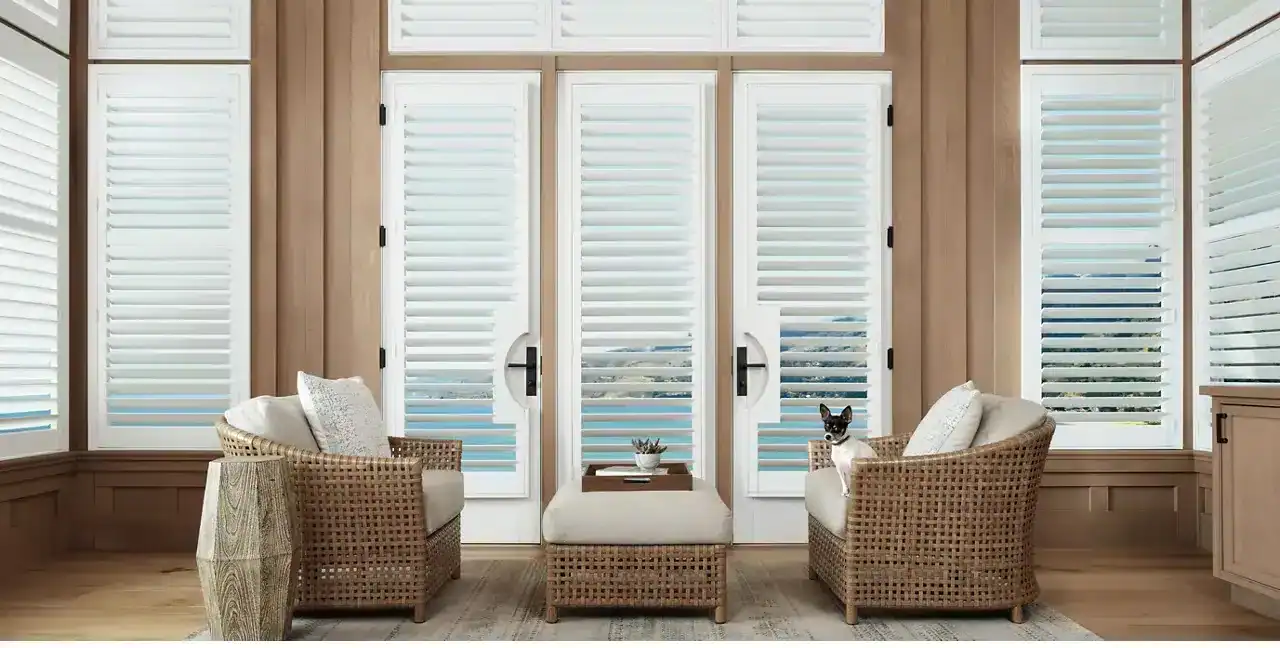
Choosing window treatments in Boca Raton means understanding that your climate demands materials built for performance, not just aesthetics. Composite shutters deliver both—the classic look of plantation shutters with engineering that handles what South Florida throws at them.
You’re investing in your home’s comfort, energy efficiency, and appearance. That investment should last decades, not require replacement every few years because the material couldn’t handle the environment.
The homeowners who choose composite shutters for their Boca Raton properties aren’t compromising. They’re making an informed decision based on how materials actually perform in high humidity, intense UV, and constant heat. They’re choosing shutters that will look and function properly for 20-30 years with virtually no maintenance.
At Miami Design Group, we specialize in window treatments and home automation solutions engineered specifically for South Florida’s demanding climate. With comprehensive design services that go beyond just window coverings—including motorized options that integrate seamlessly with smart home systems—we offer the expertise and one-stop convenience that makes your project straightforward from consultation through installation. Based in Hallandale Beach and serving Boca Raton, FL and surrounding areas, we understand exactly what your local environment requires.
Article details:
Share:
Continue learning: